
The Connected Patient & Family
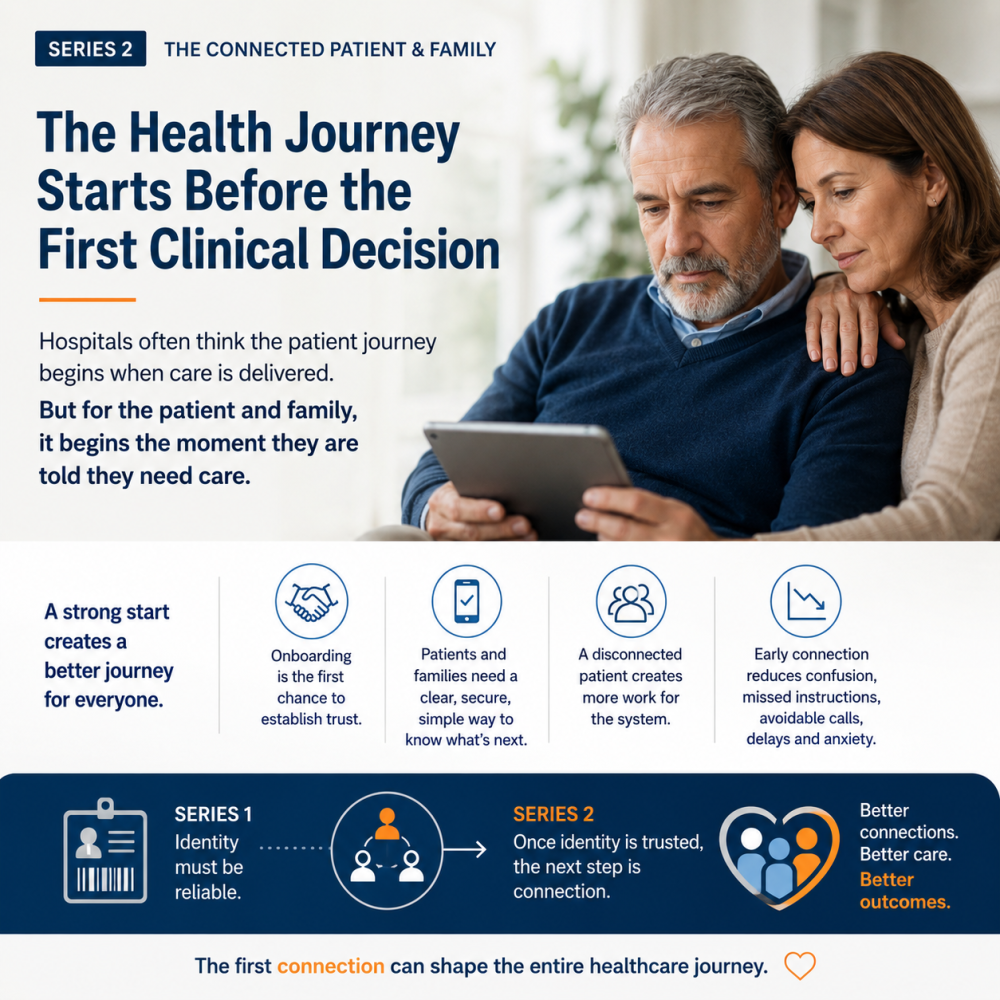
The Health Journey Starts Before the First Clinical Decision
The patient journey doesn't begin with treatment. It begins with connection.
Hospitals spend enormous effort improving what happens during care.
They optimize workflows.
Reduce wait times.
Improve clinical outcomes.
Invest in new technologies.
Implement sophisticated Electronic Health Records.
Yet one of the most important moments in the entire patient journey often receives surprisingly little attention.
The moment the patient first enters the health system. Not the first medication; not the first assessment; not even the first clinical decision.
The journey begins when someone hears the words:
"You need surgery."
"We'd like to schedule some tests."
"You'll be admitted tomorrow."
"Please come to the Emergency Department."
For the patient and their family, that is the moment everything changes.
The System Thinks Registration. The Patient Thinks, "What Happens Now?"
Healthcare organizations often view onboarding as an administrative task.
Collect demographic information.
Verify insurance.
Confirm contact details.
Hand over a portal invitation.
Print a wristband.
Move to the next patient.
From the hospital's perspective, registration is complete but from the patient's perspective, the journey has only just begun. Questions immediately appear.
Where do I go?
Who will contact me?
What should I bring?
Can my family come?
Do I need to stop taking medication?
How long will I wait?
What happens after the procedure?
Who do I call if something changes?
Patients aren't looking for another login. They're looking for confidence.
Every Future Interaction Depends on This First Connection
Think about every interaction that follows.
Pre-operative instructions.
Educational material.
Consent forms.
Appointment reminders.
Directions through the hospital.
Medication information.
Preparation checklists.
Family updates.
Discharge planning.
Recovery instructions.
Follow-up appointments.
Patient surveys.
Remote monitoring.
None of these work particularly well if the patient isn't already connected. Healthcare organizations often struggle with patient engagement later in the journey without recognizing the root cause. The connection was never established in the first place.
The Cost of a Disconnected Patient
When patients are disconnected, healthcare teams compensate.
Staff make additional phone calls.
Instructions are repeated multiple times.
Instructions are printed.
Appointments are missed.
Family members don't receive timely information.
Patients arrive unprepared.
Questions that could have been answered digitally become interruptions during already busy clinical workflows. Discharge instructions are forgotten or not understood and follow-up compliance declines. None of these failures occur because clinicians aren't committed. They occur because the communication pathway wasn't established early enough.
Every manual workaround consumes valuable clinical time.
Every unanswered question creates uncertainty for patients.
Every disconnected interaction increases workload somewhere else in the system.
Every non-compliance risks unplanned visits or potentially worsening health condition.
Trust Is Built at the Beginning
Healthcare rightly places enormous emphasis on clinical trust.
Patients trust clinicians with their health.
Hospitals protect privacy.
Identity is verified carefully.
But trust is also created through communication.
Patients need to know:
"The hospital knows who I am."
"The information I'm receiving is legitimate."
"This message is actually from my care team."
"I understand what happens next."
That confidence starts long before discharge planning or patient education – It starts at onboarding.
Families Begin the Journey Too
Healthcare rarely involves just one person: parents; spouses; adult children; caregivers. friends. These people often become critical partners throughout treatment and recovery, et they frequently remain disconnected until late in the care process or never connected.
Imagine if families could be securely connected at the very beginning—receiving appropriate updates, educational resources, preparation information, and guidance based on the patient's consent. Instead of searching for information, they become informed participants in care. Connected families often become calmer families. Calmer families help create calmer patient experiences.
Identity Was the Foundation. Connection Is the Next Step.
Throughout Series 1, we explored why reliable patient identity matters.
A barcode identifies the patient.
A wristband supports safe care.
Positive Patient Identification reduces risk.
Reliable identity creates confidence.
But identity alone doesn't improve engagement, knowing who the patient is is only the beginning. The next challenge is using that trusted identity to establish a trusted connection – not days later, not after discharge, not through an email invitation that may never be opened. It needs to happen at the very beginning of the journey—while the patient is present, known, and engaged. Why? Because once that secure connection exists, every future interaction becomes easier for both the patient and the health system.
Looking Ahead
In this new series, we'll explore what happens when healthcare stops viewing onboarding as paperwork and starts treating it as the foundation of the connected patient journey. We'll examine how early digital engagement can improve communication, reduce friction, involve families more effectively, and create better experiences before, during, and after care. We know it will also improve patient health outcomes and reduce unscheduled return visits to the hospital.
The first clinical decision may save a life, but the first connection can shape the entire healthcare journey.
About Medirex Systems Inc.
Medirex Systems Inc. (Medirex) is a Canadian-owned and operated business connecting patients to health information systems. Being an industry leader for over 50 years, Medirex has evolved to bridge the gap between patient identification and engagement by cultivating patient connections with ease, security, and no errors. Providing a positive patient identification experience for over 10 million Canadians, Medirex adopts technologies ensuring that the patient has a voice in their healthcare journey. Medirex aids in the adoption of digital health resources and data to improve the patient experience for your healthcare organization.
Media Contact:
Medirex Communications
Medirex Systems Inc.
+1.416.363.9313
info@medirex.com